top of page

home: Welcome
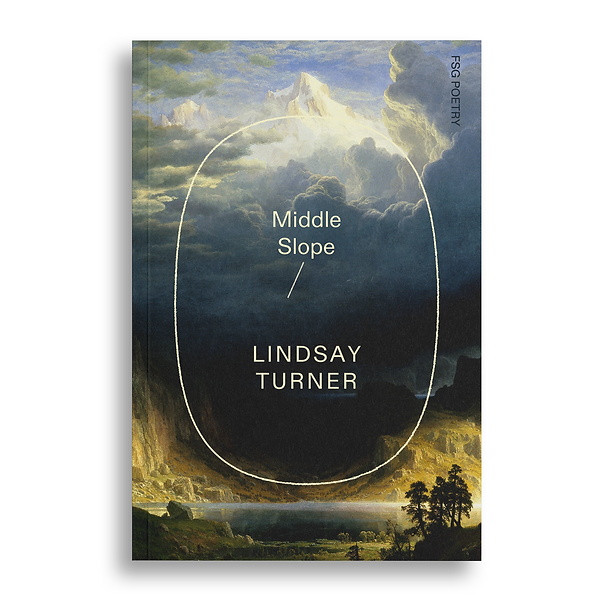
A collection of plainspoken contemporary nature poems teeming with pastoral paranoia and quiet beauty from a powerful emerging poetic voice.
(FSG, October 20, 2026)
★Starred Library Journal Review
"The consummate poet’s poet, in her third book she masters her craft... Turner fuses nature with her personal narrative and the wreckage of humanity. It is an intersection that is evocative, edgy, and beautiful... Her voice is both strong and quiet. Her words build like chord progressions, taking readers on a journey that is at once solitary and communal. VERDICT: Turner’s poetry reaches for connection and succeeds with aplomb."
Set primarily in the suburban West, below the peaks of the Rocky Mountains—land of cold snaps and blinding sun, dusty urban sprawl and wayward wildlife—Middle Slope is about mountain ecologies, the changing climate, infertility, and uncertainty.
Between the extremes of peaks and valleys, the poet finds herself on the “middle slope,” in a stilled, failed, and frozen time. Lindsay Turner’s third collection is carnal, intimate, chthonic, and animal. These are nature lyrics, but with a view of nature that is distinctly contemporary, a vision of the natural world that is by us endangered and from which we are alienated. Through repetition, striking imagery, and simple expressive language gone awry, these poems capture a deep, slow thawing, things beginning to ease up and open. Contrasting the cyclical nature of seasonal change with the ruptures and comings-together of the romantic dyad, Turner captures a transformation that is both everyday and sublime.
THE UPSTATE
fall 2023, University of Chicago Press
Set in a landscape of red sunsets and wildfire smoke, Queen Anne’s lace on the roadsides, and toxic chemicals in the watershed, Lindsay Turner’s THE UPSTATE is a book about southern Appalachia in a contemporary moment of change and development. Layering a personal lyric voice with a broader awareness of labor issues and political and ecological crises, THE UPSTATE redefines a regional poetic as one attuned to national and global systems. These poems observe and emote, mourning acts of devastation and raging in their own quiet way against their continuation.
The poems in THE UPSTATE arise from moments of darkness and desperation, mobilizing a critical intelligence against the status quo of place and history, all while fiercely upholding belief in the role of poetry to affect these conditions. Turner’s poems weave spells around beloved places and people, yearning to shield them from destruction and to profess faith in the delicate beauties of the world at hand.
on THE UPSTATE
“Turner has been a poet to watch since before her first book; she has also become a poet to marvel over, a poet carrying poetry into the next decades. But The Upstate is more than just an affirmation of what Turner’s readers already knew—it is a catalog of the impossibilities of living in the present cultural moment, and yet it resolves itself in hope, in a vision of the possibility of ‘money without death,’ and so a vision of a world better than any world before it. Turner sees a future world that is better than it could be, and in The Upstate she takes her poetry there. This is a salvific book.”—Shane McCrae, author of Cain Named the Animal
“These words will always stay with me: ‘The question is who does your money come from / The question is whose loss.’ With lyric force, Turner expresses the magnitude of toxic wreckage in the landscapes of southern Appalachia, as well as the scales of sorrow for a country and world that pretend wealth comes at no cost. Her exquisite poems grieve precisely for people, water, trash, animals, air, flowering trees. I feel lucky to have The Upstate in my hands and its cadences in my body, reminding me. ‘Who can’t live the thing she wants which is good and reasonable / Because of your money.’”—Joanna Klink, author of The Nightfields
“The Upstate packs teeming lack. Turner has worked a poetry of muscular disgust for plutocracy. Track how the poet tends to glare then look askance, but in a way that damns, not frets. Who ends a poem with 'credible, credible’? The same poet who, when near subsumed in impressionistic flood, brickwalls the lines into remarkable crush: ‘Burning transparent all the way up to the top where the workers / Rise into a general collective of all they wouldn’t offer.’ Turner, that’s who. The Upstate is an uppercut as statement. That’s what.”—Douglas Kearney, Phoenix Poets consulting editor and author of Sho
“This memorable, original book begins with an American place—upstate South Carolina—as Turner’s guide. For her, this centering of poetry in place means dislocation, not
orientation. Through this collection, Turner makes a unique contribution to contemporary American poetry, mixing a faith in poetic form’s sonic insistences with a lack of faith in social consensus, turning individual poems into energetic hubs of discord.”—Katie Peterson, Phoenix Poets consulting editor and author of Life in a Field
Lindsay Turner / poet & translator
www.lindsaykturner.com


bottom of page